Whether you're hiring your first ten engineers or your hundredth, the question keeps coming back: do you pay a recruiter a monthly retainer, sign up to a job board, or only pay when a role closes? The answer lies in a variable most founders underestimate — the real cost of a bad hire.
The Subscription Model: Consistent Cost, Uncertain Results
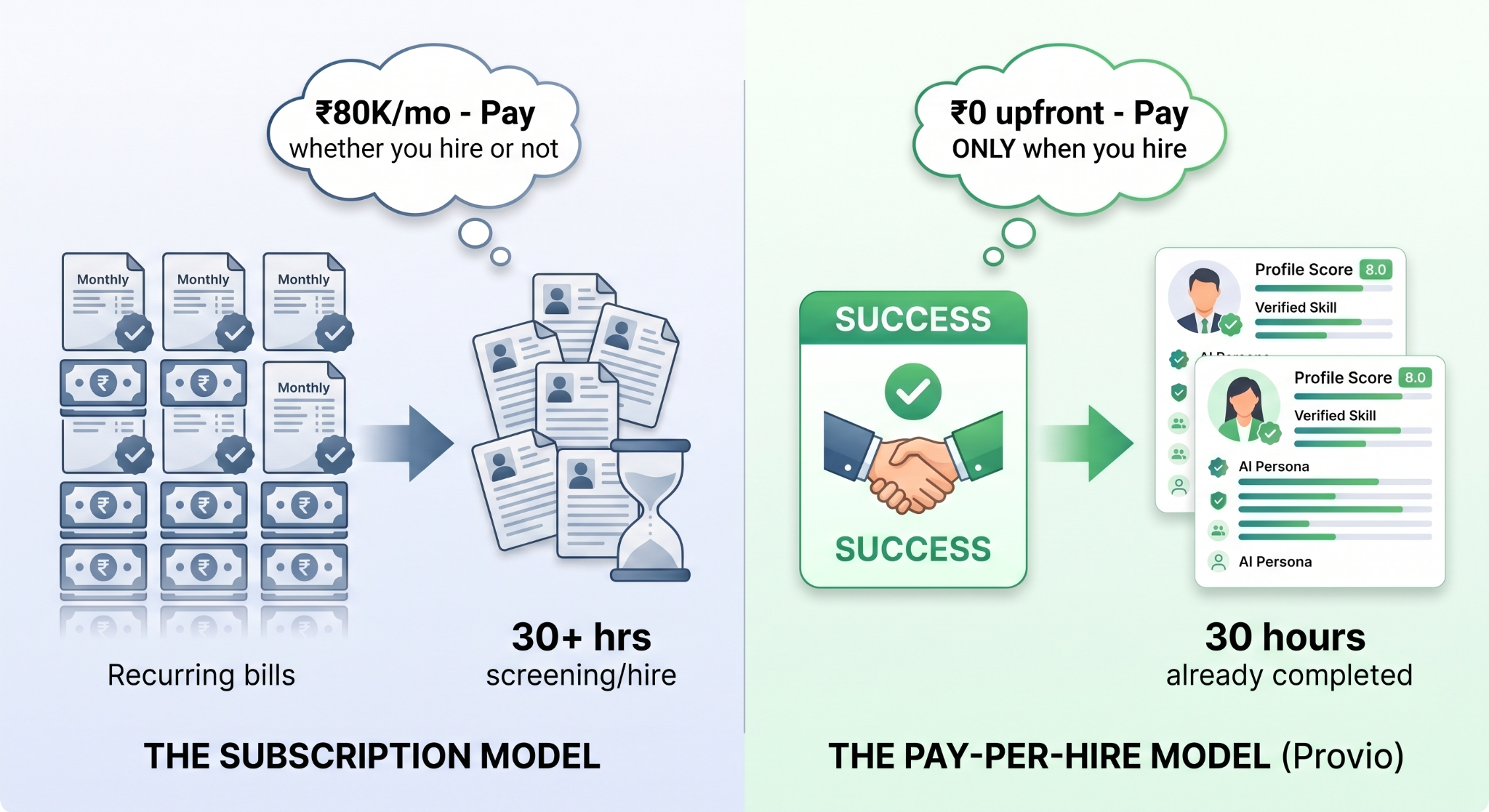
Conventional job boards — Naukri, LinkedIn, Indeed — charge a monthly or annual subscription to access their candidate database. You pay whether you hire or not. An average Naukri subscription runs ₹25,000–₹80,000 a month for a startup. LinkedIn Recruiter starts around ₹60,000 a month.
The predictability pitch is strong — you know your cost in advance. But what you get at that price is the problem: a database of candidates self-reporting their skills, unverified, high-volume and low-signal. You're paying to hear noise.
₹60K/mo
Avg. subscription cost
30+ hrs
Screening per hire
₹15–40L
Cost of a bad hire
The Retainer Model: High Cost, Misaligned Incentives
Traditional recruitment firms charge ₹20,000–₹1,00,000 per month as a retainer, plus an 8–15% success fee on the annual CTC of every hire they place. The retainer model has a structural incentive-misalignment problem — agencies get paid monthly whether they close a role or not. There's no urgency built in.
For a startup hiring a senior engineer at ₹24 LPA on a 5% placement fee, you pay ₹1.2 lakh on top of the retainer you already paid. Five hires means ₹6 lakh in placement fees alone — before retainer costs.
Pay-Per-Hire: Risk Transfers to the Platform
Pay-per-hire inverts the incentive system entirely. You don't pay anything until a candidate is successfully onboarded. The platform carries the burden of sourcing, verification, and filtering. Until you close, you incur no cost.
Provio runs on a pay-on-hire model. No subscription, no retainer, no upfront commitment. You get a pool of pre-vetted candidates — each profile includes a Profile Score, a verified skill breakdown, and an AI-generated persona. The 30 hours of screening work? Already done on the platform.
With a subscription, you buy access to candidates. With pay-per-hire, you buy access to the right candidate. That is a fundamentally different transaction.
The Real Cost Comparison
Take a Bangalore startup that needs to hire five engineers over two months. Here's how the three models stack up:
Subscription model
₹80,000/month × 2 = ₹1,60,000 in platform fees, plus 30 hours of screening × 5 hires = 150 hours of internal engineering and HR time, at an opportunity cost of ₹3–5 lakh. Total: ₹4.5–6.5 lakh.
Retainer + placement
₹50,000/month retainer × 2 + ₹2L per placement × 5 = ₹11 lakh. Plus you still do internal screening on the shortlist.
Pay-per-hire (Provio)
Zero upfront. A per-hire success fee only when someone is onboarded. No screening time — candidates are already verified. No retainer. No subscription.
When Subscription Makes Sense
To be fair, subscription models make sense when you're hiring at scale — 50+ hires a year — where per-role economics improve with volume, and you have a dedicated pipeline manager. For startups hiring fewer than 20 people a year, pay-per-hire is almost always cheaper.
Rebuilding the hiring layer on truth means pricing for results, not effort. When the platform only gets paid when you hire, its incentives align with yours — to surface candidates actually worth hiring.
Post a role. Pay when you hire. → provio.in
Written by
Provio Team
We write about verification, AI hiring, and the future of work in India. Our goal: give founders and candidates the signal they need — no noise.
More Articles