One number. Two halves. Eight components. Here's a full, no-fluff breakdown of exactly how Provio calculates your 0–100 Profile Score — built from the same system used in real verification.
Your Score Has Two Halves
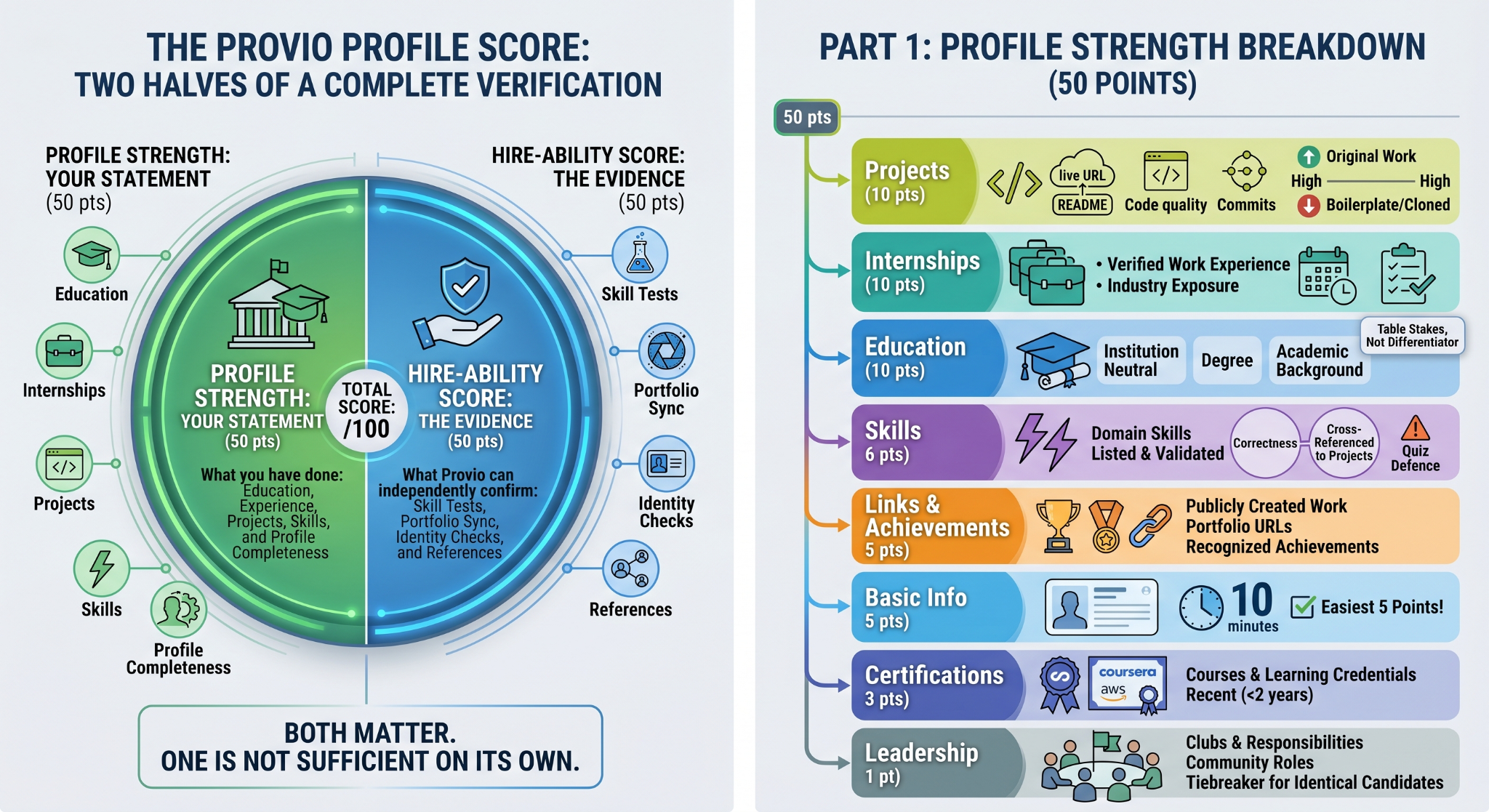
The Profile Score is a number out of 100. But it isn't one thing — it's the sum of two completely separate systems, each worth 50 points:
Profile Strength
0 – 50 points
What you have done — your education, experience, projects, skills, and profile completeness.
Hire-Ability Score
0 – 50 points
What Provio can independently confirm — through skill tests, portfolio sync, identity checks, and references.
Think of it like this: Profile Strength is your statement. Hire-Ability is the evidence. Both matter. Neither is sufficient on its own.
Part 1 — Profile Strength (50 Points)
This half measures how deep and complete your profile is, across eight components. Each one is weighted by how much signal it gives employers. They all answer the same question: how well have you built your professional identity?
| Component | Max Points | What It Measures |
|---|---|---|
| Projects | 10 | GitHub repos, deployed work, code quality signals |
| Internships | 10 | Verified work experience and industry exposure |
| Education | 10 | Degree, institution, academic background |
| Skills | 6 | Domain skills listed and validated on profile |
| Links & Achievements | 5 | Portfolio links, awards, recognitions |
| Basic Info | 5 | Profile completeness: name, bio, contact details |
| Certifications | 3 | Courses, certificates, and learning credentials |
| Leadership | 1 | Clubs, positions of responsibility, community roles |
Projects — 10 Points
The most important element in Profile Strength. Provio examines your connected repos and deployed work — not just whether they exist, but code structure, documentation, test coverage, commit consistency, and complexity relative to your experience level. Boilerplate and cloned work are detected and weighted down. Projects that are documented, deployed, and original score the highest.
Tip
Connect your top 2–3 projects with live URLs or GitHub links. Write a concise README for each. Invest real time — not just weekends.
Internships — 10 Points
Industry exposure is weighted heavily compared to pure academic performance. Credible internships — especially those with documented outcomes or contributions — have a big impact on your Strength score. Vague or unverified entries score lower until confirmed by the Hire-Ability layer.
Tip
Even a 2-month internship counts. Include your role, the organisation, and what you specifically built or contributed. Vague descriptions score lower.
Education — 10 Points
Your college, university, and academic background. This is deliberately capped at 10 points — a degree is table stakes, not a differentiator. It's verified further in the Education Identity check on the Hire-Ability side.
Skills — 6 Points
The skills you list are cross-referenced against your projects and tested in the Skill Testing module. If you list skills you can't defend, your Hire-Ability score drops — even if your Profile Strength stays intact. Here, accuracy matters more than quantity.
Tip
Only list skills you can defend in a quiz. Skills tied to your project work that also pass the domain test score the most.
Links & Achievements — 5 Points
Portfolio URLs, competition wins, open-source contributions, published articles, and recognised achievements. This rewards candidates who've built publicly — work that lives on the internet, not just on a resume.
Basic Info — 5 Points
A complete profile: name, bio, contact details, photo, and profile summary. The easiest 5 points on the board. A complete profile signals professionalism, and it ensures you appear correctly in company search results.
Tip
Fill every field. Ten minutes to fix — there's no reason to leave these points on the table.
Certifications — 3 Points
Online certifications from platforms like Coursera, NPTEL, AWS, or Google. These carry more weight if they're directly tied to your listed skills and recent (within the last two years).
Leadership — 1 Point
Clubs, responsibilities, community roles, event organising. The smallest component — but a meaningful tiebreaker between otherwise identical candidates. It signals activity beyond academics.
Part 2 — Hire-Ability Score (50 Points)
This is the verification layer. Part 1 is all self-reported. This half independently verifies it — through testing, document validation, third-party platform checks, and references. Any profile with a Hire-Ability score of 0 is hidden from company dashboards, no matter how strong Part 1 looks.
| Component | Max Points | Sub-criteria |
|---|---|---|
| Skill Testing | 18 | Quiz score across your domain skills |
| Portfolio Sync | 18 | LinkedIn PDF (6) + GitHub (6) + LeetCode (6) |
| Education Identity | 10 | Mandatory docs (5) + Identity confirmed (3) + Extra docs (2) |
| Reference Verification | 4 | Reference 1 (2) + Reference 2 (2) |
Skill Testing — 18 Points
The single biggest component in the 100-point system. You take an adaptive quiz across your chosen domains. The more you get right, the harder the questions get. Your score reflects not just correctness — but the complexity level you can actually handle.
This is where most candidates leave points on the table. Listing a skill you haven't actually practiced means it'll show up in the quiz — and a low quiz score against a high self-reported Skills score is a visible discrepancy that companies can see.
Tip
Focus on your best 2–3 areas, then take the quiz. Don't wander into areas you can't hold under adaptive pressure. One strong domain beats three weak ones.
Portfolio Sync — 18 Points
Provio connects directly to three external platforms, each worth 6 points:
LinkedIn PDF — 6 points
Your LinkedIn profile (PDF) is analysed and compared against your Provio profile to verify consistency.
GitHub — 6 points
Commit history, contribution graph, repo quality, and activity timeline are all analysed. Forks without meaningful contribution are weighted down.
LeetCode — 6 points
Problem-solving history and difficulty distribution matter. Consistent activity over time scores higher than a single burst.
Combined, Portfolio Sync answers a single question: does this candidate exist online in the way they claim?
Tip
Link all three platforms before submitting for verification. A partial LeetCode history beats none at all. A blank GitHub is a red flag for any engineering role.
Education Identity — 10 Points
This is where your education claim becomes a verified fact. Three sub-checks:
Mandatory documents — 5 points
Your enrolment or degree certificate, uploaded and examined.
Identity confirmed — 3 points
A government-issued ID cross-checked against your profile.
Extra docs (high trust) — 2 points
Additional documents like transcripts, mark sheets, or offer letters that raise confidence.
Tip
Upload legible scans. Blurry or cropped documents slow down verification — and can cost you the full 10 points.
Reference Verification — 4 Points
Two sources, 2 points each. People who can vouch for your work, projects, or character — a professor, internship manager, or senior collaborator. Provio contacts them. A confirmed reference adds 2 points and a credibility signal that no self-reported data can match.
Tip
Pick sources who'll actually respond. A reference who never replies contributes 0 points, no matter who they are.
Score Interpretation Guide
Your total Profile Score = Profile Strength + Hire-Ability Score. Here's what each range means in practice:
| Score Range | Rating | What It Means |
|---|---|---|
| 85 – 100 | Elite | Immediately hireable. Proactively surfaced to top-tier companies. |
| 70 – 84 | Strong | Above average. Shortlisted for most roles matching your skill set. |
| 55 – 69 | Developing | Solid in one or two areas. May need additional screening. |
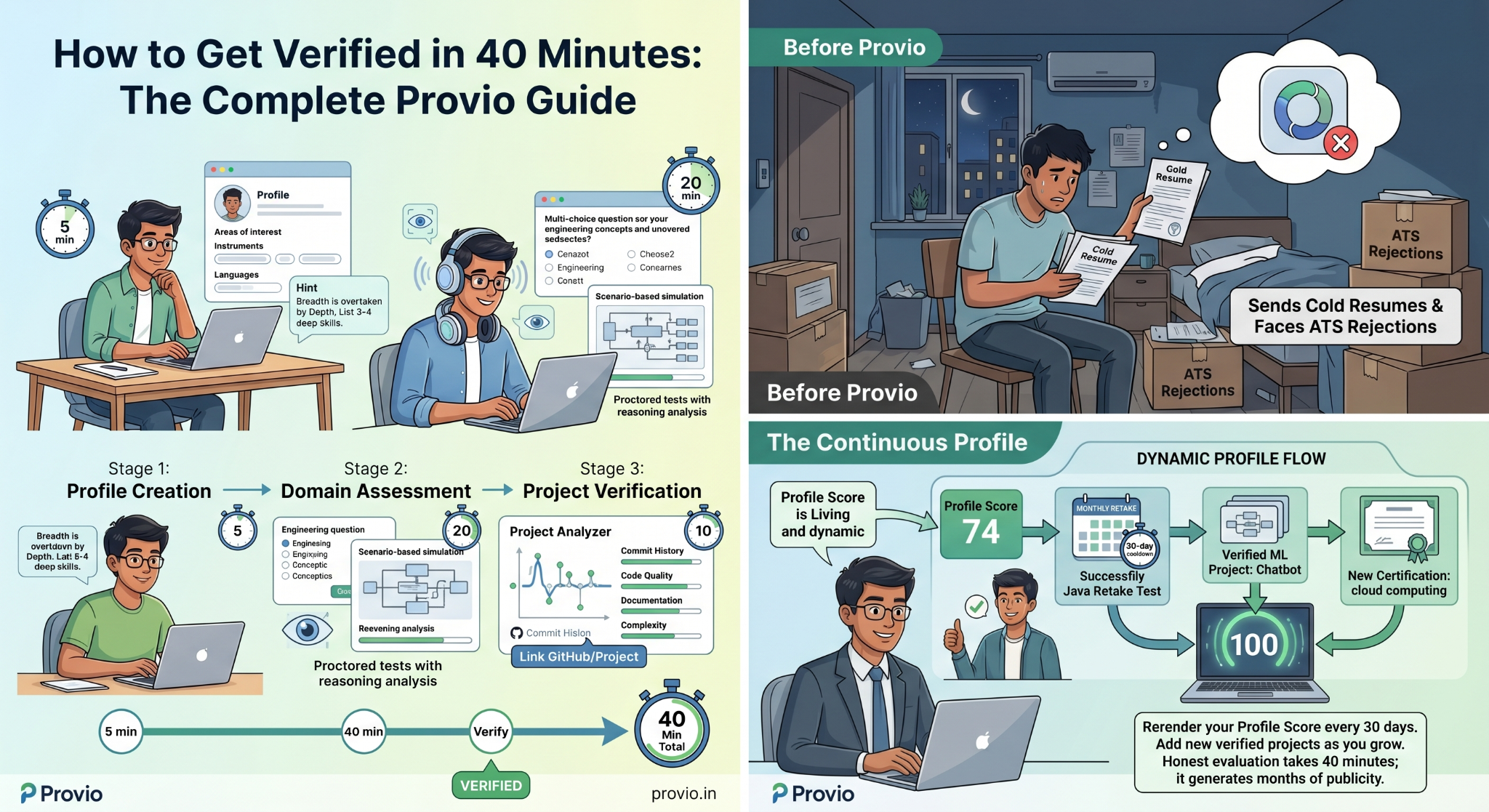
| Below 55 | Early Stage | Keep building. Retake eligible after 30 days. |
The Bigger Picture
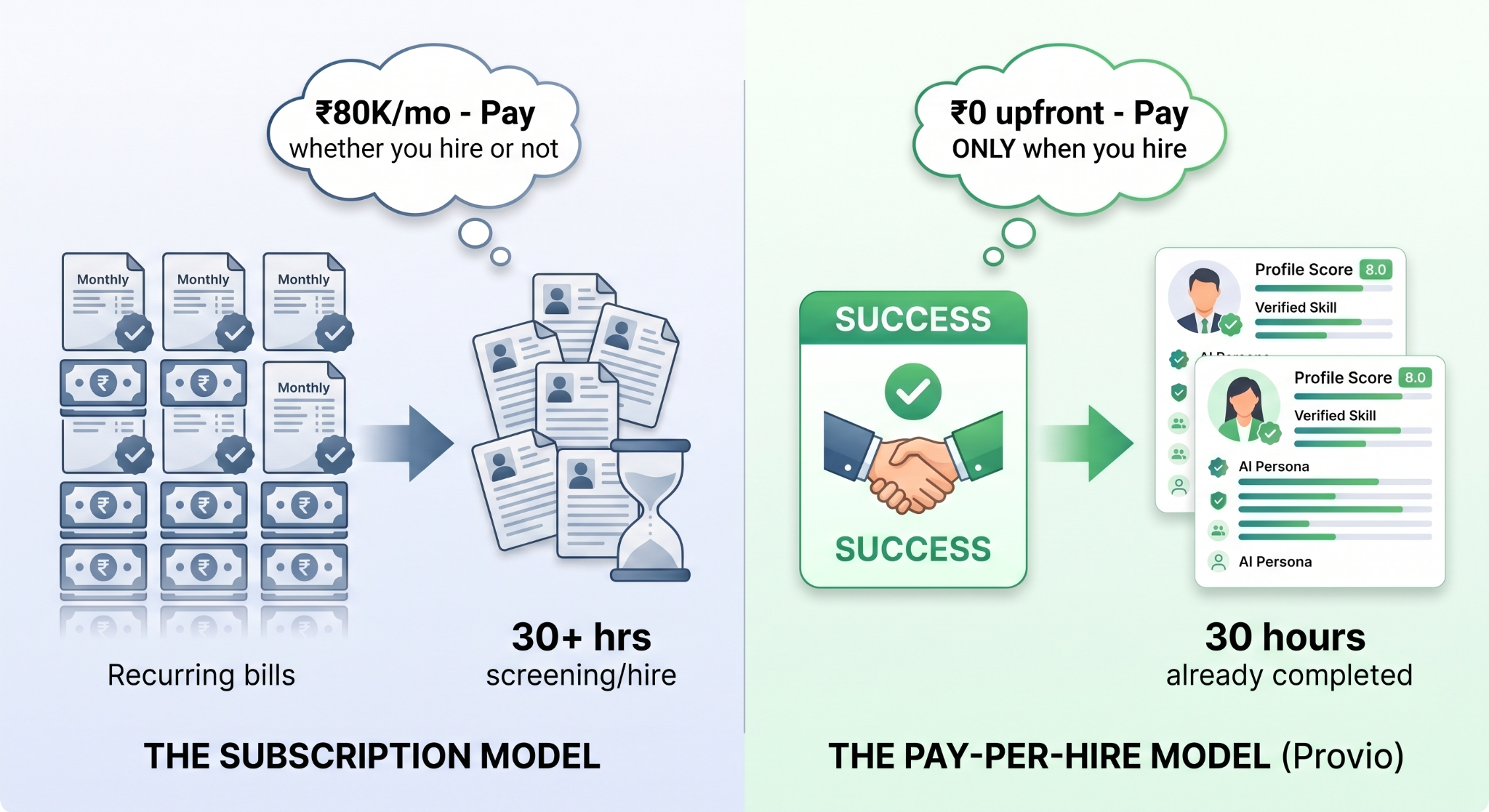
One in six candidates exaggerates skills on their resume. Employers know this — so they screen 30+ hours per hire, and still don't know what they're getting. Candidates, meanwhile, apply to 50+ roles and get 3 replies.
The two-part score exists to close that information gap. Profile Strength tells you how strong your story is. Hire-Ability tells employers whether the story is true.
A candidate with a 78 Profile Score has been seen. Evaluated. Confirmed. That is categorically different from a 9.0 CGPA on a PDF.
See your Profile Score. → provio.in
Written by
Provio Team
We write about verification, AI hiring, and the future of work in India. Our goal: give founders and candidates the signal they need — no noise.
More Articles